


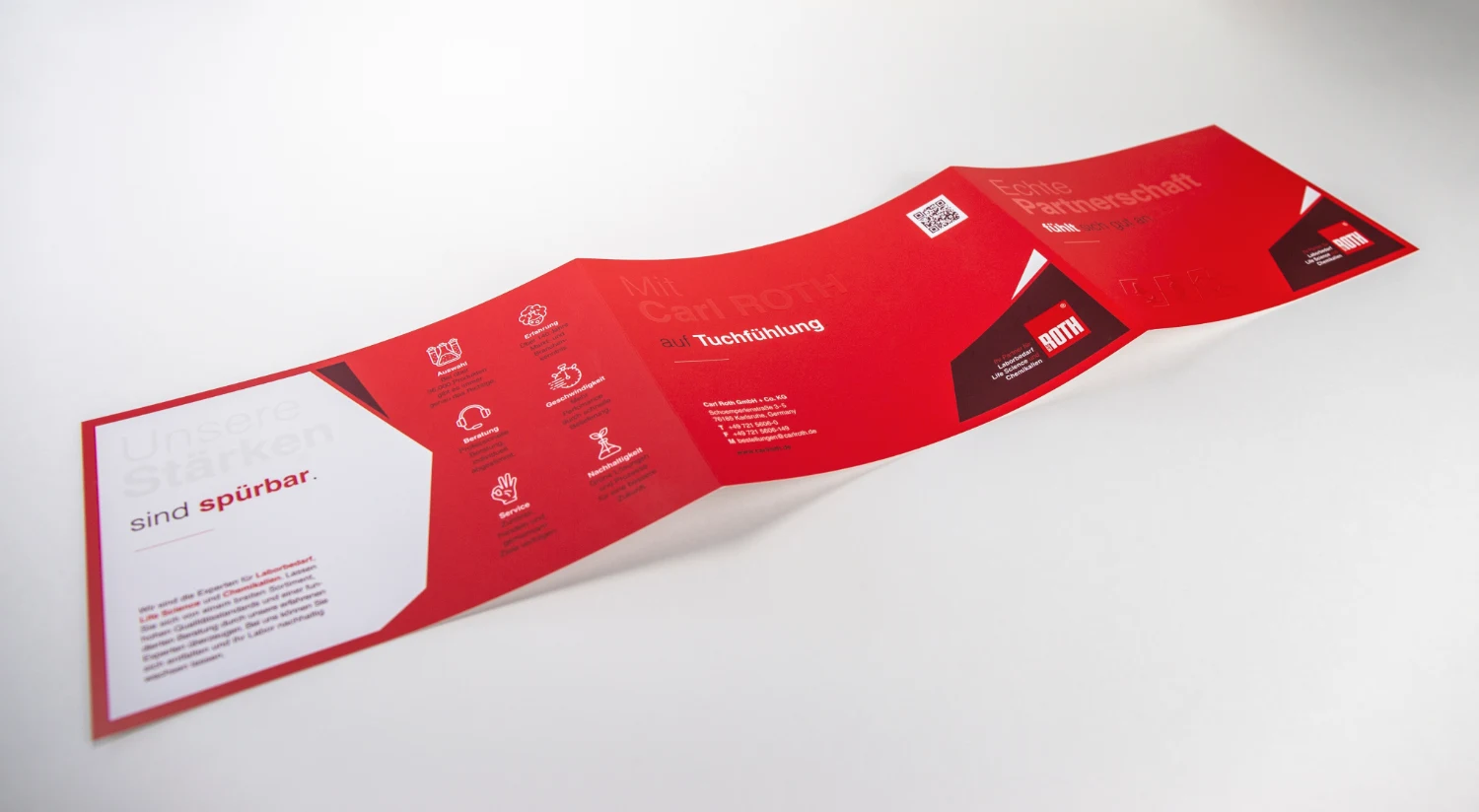
Roll fold, concertina fold or cross fold: which suits your content?

Two leaflets can have the same closed size and the same number of pages, yet read very differently. One opens with a single flap; the other unfolds into a sequence of equally prominent panels.
The folding method determines which information is seen first, which content appears together and how much can be viewed at once. It should therefore be decided before the final arrangement of text and images.
One simple question helps you choose: should readers be guided through a topic step by step, compare several pieces of information side by side, or open out a large, continuous image?
How a fold transforms a printed sheet
Folding creates a defined crease in a sheet of paper. This divides it into panels that together form the finished print product.
For example, a sheet folded in half has four printable pages: a front, a back and two inside pages. Two parallel folds can create a six-page leaflet. “Six-page” means six designable surfaces, rather than six separate sheets of paper.
Planning involves two different sizes:
- Open size: the dimensions of the fully unfolded product.
- Closed size: the dimensions when fully folded.
Both are important. A compact leaflet can open out into a surprisingly large area.
The main folding methods at a glance
| Folding method | Structure | Possible use |
|---|---|---|
| Half fold | One fold, often in the centre; four pages | Invitation, brief service overview |
| Roll fold | Panels fold inwards around another panel; typically six pages | Company introduction, product information |
| Concertina fold | Parallel folds in alternating directions; also known as an accordion fold | Programme, schedule, structured overview |
| Cross fold | Successive folds at right angles to each other | Overview map, plan, fold-out graphic |
The basic methods differ mainly in the direction and arrangement of the folds. A cross fold with two folds, for example, produces eight page surfaces.
Technical overview of folding methods (in German)
The best choice for your content depends on how the product will be used.
Roll fold: reveal information as the leaflet opens
For a service overview, a roll fold can create a clear sequence: the cover introduces the main topic, the first opening reveals a brief introduction, and the fully opened leaflet presents more detailed information.
One example is a six-page leaflet promoting a consultancy service:
- The cover identifies the purpose and benefit of the service.
- The fold-in flap answers the reader’s first important question.
- The three inside panels explain the services, process and requirements.
- The back contains contact details and the next step.
This is one possible editorial arrangement. The exact position of each panel must be established using a folded mock-up.
From a production perspective, the fold-in flap needs particular attention. It is usually made slightly narrower to leave enough room when closed. The required reduction depends on the construction and paper. Three equal-width columns are therefore not automatically a suitable template for a roll fold.
Concertina fold: show connections side by side
A concertina fold is suitable when the panels need to work as a continuous sequence.
For an event programme, the panels might cover different parts of the day. In a service overview, each panel could have its own subject. A process can run across several panels from the first step to the outcome.
The design should also make sense when fully open. Consistent headings, a shared grid and clear transitions help readers find their way.
A continuous image or graphic can connect the panels. Important details, however, should not fall on a fold by accident. A product name, a face or a small number may become harder to see there.
Also consider whether the product is intended to be read from one side only, or whether either outer face can be the starting point. This affects the cover, labelling and reading direction.
Cross fold: fit a large surface into a compact format
A cross fold can be useful when the open product is primarily intended to be viewed as a whole. Examples include a site plan with labelled areas or a technical overview.
For such a plan, the closed front could carry a clear title. Opening it reveals the complete image, with additional explanations on the other side of the sheet.
Content orientation is particularly important with this construction. Some elements may need to be rotated on the open press sheet so that they appear the right way up when opened as intended.
A cross-folded product does not automatically read like a small booklet. If readers are expected to turn from one page to the next in sequence, check that the chosen construction supports this.
Make a paper mock-up before creating the layout
An unprinted folded mock-up takes little time and answers questions that are easy to miss on screen.
A sheet of paper is enough for an initial draft:
- Cut it to roughly the planned open size.
- Fold it in the intended sequence.
- Label the cover and back of the closed mock-up.
- Open it step by step and note the purpose of each visible panel.
- Unfold it fully and transfer the arrangement to your layout.
This checks the logic of your content. A production template is then needed to establish the final panel widths and fold positions.
Show the mock-up to someone unfamiliar with the project. Do they open it as intended? Can they find the contact details? Do they understand where the text continues? These observations are often more useful than another discussion about the on-screen layout.
Choose paper and folding together
How a leaflet opens and closes also depends on paper thickness, stiffness, surface and grain direction.
A substantial paper may work well for a simple folded card. With several panels folding into one another, however, its thickness takes up extra space. The construction must allow for this.
Depending on the paper and printing, creasing before folding may be advisable. It prepares the fold line and can reduce the risk of visible cracking. Whether it is needed cannot be determined by a universal paper-weight threshold alone.
When folds run in several directions, different grain-direction requirements must also be balanced. Material selection should therefore be discussed with the finishing team early on.
A mock-up made from the intended paper then tells you more than one made from ordinary copier paper: it lets you experience the thickness, spring-back and handling.
Checklist: what to decide before finalising the layout
The following details should be clearly defined before production:
A good leaflet brings content and handling together. It opens intuitively, provides enough space for its information and works when it is actually needed.
Printmedia experts works with you to agree the format, material and finishing & binding, including custom folds and bespoke print projects.
Enquire about a project
Read more
 Print files
Preparing print-ready artwork: understanding bleed, safety margins and image resolution
Bleed, safety margins and image resolution explained clearly, with a checklist covering format, colours, fonts and PDF export for reliable print files.
Read article
 Paper & materials
Grammage, bulk and opacity: what defines paper quality?
The same weight, a different feel: why papers vary in thickness, opacity and texture, and how to choose the right material.
Read article