


Planning sustainable print: how paper, print runs and finishing affect material use

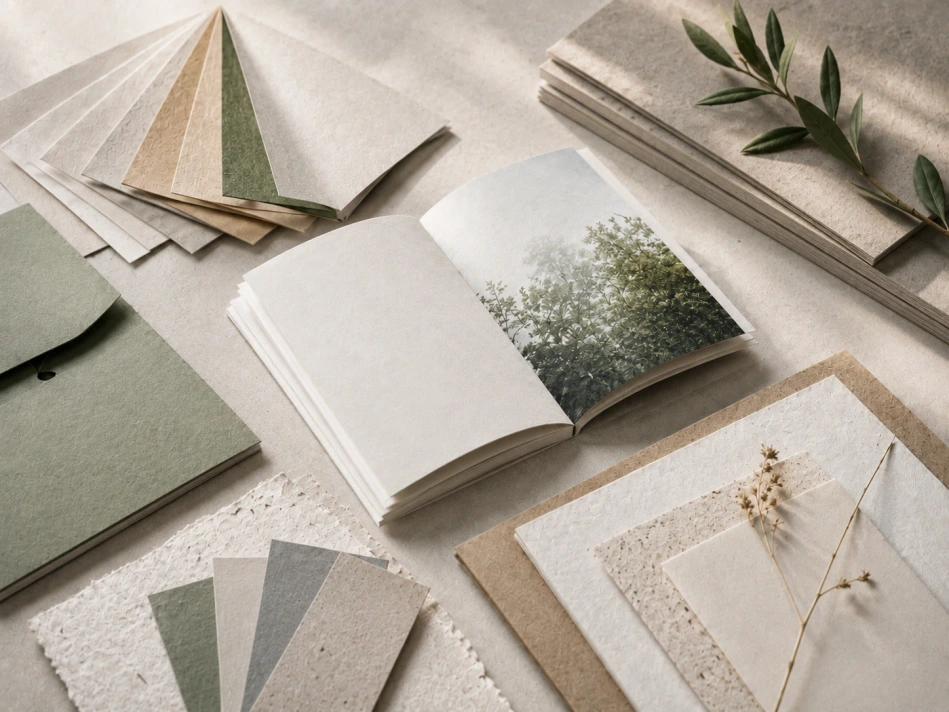
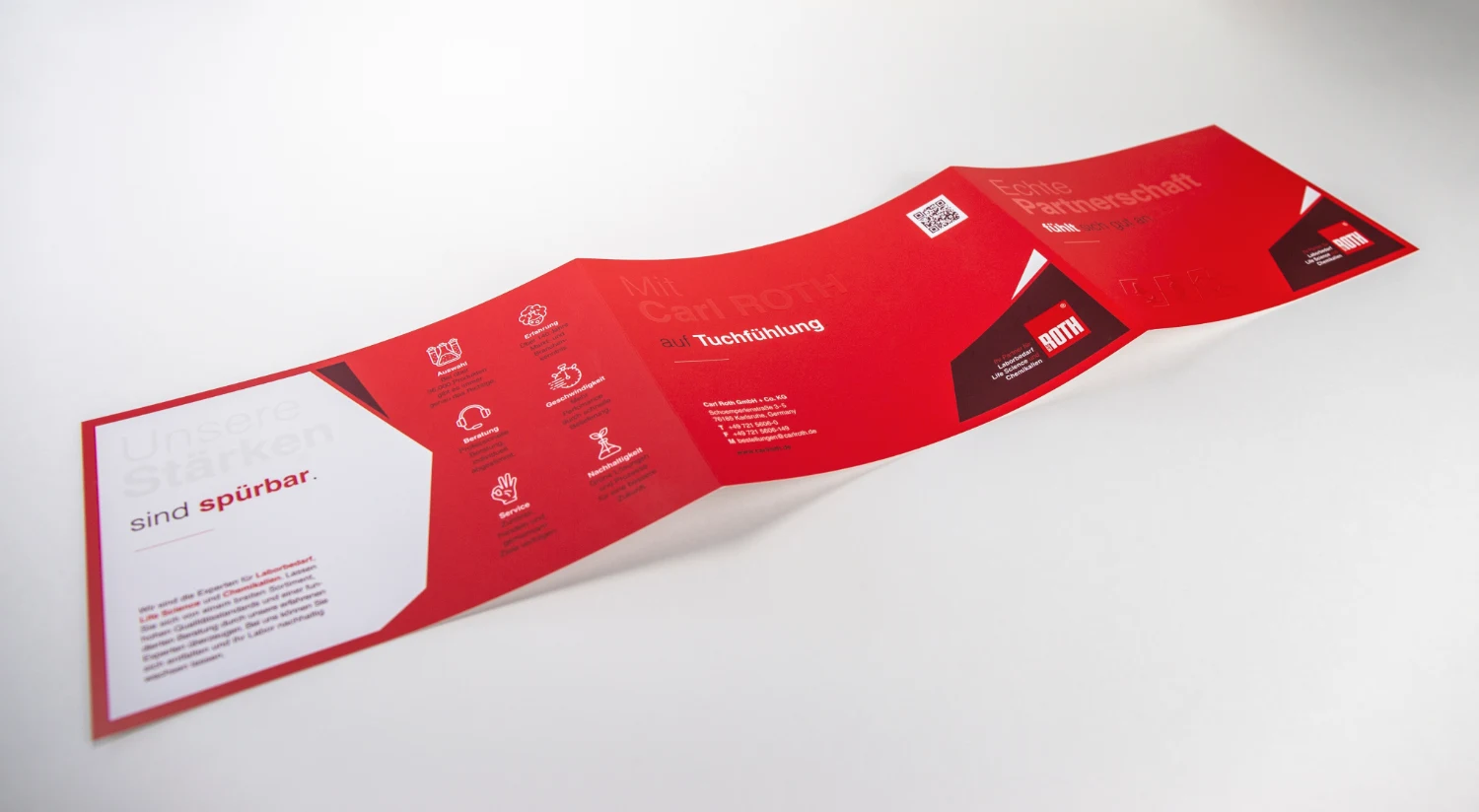
A physical sample helps assess paper, page count and finishing together.
Much of a brochure's material requirement is determined before printing begins: by its format, page count, paper and print quantity. Adding a protective layer changes both the surface and the material structure. Content that quickly becomes outdated shortens its useful life. Planning these decisions together helps you use resources more carefully and avoid unnecessary surplus stock.
Planning sustainable print therefore means looking at the complete job. Which specification will do what is needed? How many copies will actually be used? And can the finished product be recycled effectively after use? The answers need to reflect the actual materials and production route.
Start with how long the content will remain current
A company profile used for two years needs a different approach from a catalogue with prices that change every quarter. Before choosing paper, establish the intended lifespan, distribution routes and update schedule. For an exhibition, distinguish between copies needed by visitors, follow-up mailings to interested contacts and a justified reserve.
Where information changes regularly, separating long-lasting content from short-lived details can make sense: for example, a product brochure with a replaceable price sheet. A maintained digital supplement is another option. The printed publication should remain useful in its own right, and any linked content needs ongoing maintenance. Separate inserts also add material and packing work, so the approach should match the actual need for updates.
Choosing paper: check fibre sourcing and fitness for purpose
Recycled paper is a useful starting point for material selection. The German Environment Agency's 2022 life-cycle assessment reports average reductions of 78 per cent in water use, 68 per cent in energy use and 15 per cent in CO₂ emissions compared with virgin-fibre paper production. These figures describe the paper comparison studied. They are not guaranteed savings for a particular brochure including printing, finishing and delivery. [1]
Samples help establish whether a paper is suitable. Check small-text legibility, dark images showing through the sheet, colour reproduction and how the pages withstand handling. Paper shade and surface affect the appearance of images. An unprinted sample helps assess the feel; an appropriate printed sample provides more useful evidence for critical artwork.
When assessing labels, establish exactly what they cover. Certification of the paper and certification of the finished printed product address different things.
| Label | What it means for your specification |
|---|---|
| Blue Angel for paper (DE-UZ 14a) | Paper made from 100 per cent recovered paper, with additional requirements for production and fitness for use. [2] |
| Blue Angel for printed matter (DE-UZ 195) | Also covers the printing process, materials used and recyclability of the finished product. [3] |
| FSC Recycled | The wood- or paper-based components covered by the label come from recycled material. [4] |
| FSC Mix | Covers certified and/or recycled materials together with controlled sources. The label does not guarantee a particular recycled content. [4] |
Include any required label in the initial enquiry. This allows the materials, production route and conditions for labelling the finished product to be agreed in advance. Certified paper alone does not automatically make a printed brochure a correspondingly certified printed product. [3] [4]
What a reduction of 20 g/m² changes in a brochure
At the same paper area, a lower grammage reduces mass. It is appropriate when opacity, strength and production requirements are still met. Grammage describes mass per unit area; thickness, stiffness and opacity need separate assessment. Our article “Grammage, bulk and opacity: what defines paper quality?” explains these relationships.
A worked example shows the scale of the difference. A project requires 2,000 A4 brochures with 32 text pages and a separate four-page cover. Option A uses 135 g/m² paper for the text, while option B uses 115 g/m². Both use 250 g/m² for the cover. The 32 text pages represent 16 leaves at the finished size; the cover represents two further leaves.
| Item | Option A | Option B |
|---|---|---|
| 32 text pages | 135 g/m² | 115 g/m² |
| 4 cover pages | 250 g/m² | 250 g/m² |
| Paper mass per copy | 165.9 g | 145.9 g |
| Paper mass for 2,000 copies | 331.8 kg | 291.9 kg |
The difference is approximately 39.9 kg of paper, or 12.0 per cent of the paper mass including the cover. The calculation uses the A4 area of 0.210 × 0.297 = 0.06237 m². For option A, the paper mass per copy is: 0.06237 × (16 × 135 + 2 × 250) = 165.9042 g.
This is a material calculation, not a life-cycle assessment. It excludes trimming waste, production allowances, ink, binding materials and packaging. The actual quantity of paper purchased is therefore higher. CO₂ emissions and delivery costs do not automatically decrease by the same percentage. A sample using the intended content and binding is needed to establish whether option B is suitable.
Agree the format and page count before designing the layout
A brochure's finished size is only one part of production planning. Several pages are arranged on a larger press sheet before folding, trimming and binding. This arrangement is called imposition. It must account for sheet size, folding scheme, binding and paper grain direction. [5]
A format that fits one press sheet efficiently may be less suitable for another press or finishing process. A blanket rule such as “A4 always produces the least waste” is therefore unhelpful. Before finalising the design, ask for two or three suitable formats to be compared against the actual production route. Bleed, gripper margins and finishing requirements need to be included.
Page count also affects the construction. A conventional saddle-stitched brochure, without special inserts or other unusual features, is planned in multiples of four pages. A late layout change can therefore affect more than a single page. Have the printer confirm the format and page count before building the complete layout around them.
Base the print run on actual use
A larger print run can reduce the unit price. What matters financially and environmentally, however, is how many copies are used while the content remains current. Previous stock movements, usable existing stock, confirmed events and requirements at individual locations provide a practical basis for forecasting. Any reserve should have a clear purpose.
If demand is uncertain, request two quotations: one for the full quantity and another for a smaller first run with a realistic reprint scenario. Compare total cost, material requirement, availability and the risk of outdated surplus stock. Several small runs can require additional press setups and deliveries. A single large run can leave more unused copies. The better option depends on consumption and how quickly the content changes.
Digital and offset printing should be quoted for the specific job. There is no universal run-length threshold that identifies the cheaper or environmentally preferable option for every project. Paper, page count, personalisation, press configuration and likely reprints all belong in the comparison.
Assess finishing by its purpose and material structure
A cover that is handled frequently or used for a long time may need protection. The same additional layer may be unnecessary for short-lived information. First define what the finish needs to achieve: resistance to scuffing, greater strength, a tactile feature or a visual accent.
The processes are technically different. Blind embossing or debossing shapes the material without applying an additional ink or foil layer. Film lamination bonds a plastic film to the paper. With foil transfer, the carrier film does not remain on the product; a thin decorative layer is transferred. Film lamination and foil transfer therefore need separate consideration when assessing materials. [7] [8]
Recycling performance depends on the complete construction. For graphic printed products, relevant factors include ink removal, known as deinking, and the removal of adhesives. A good result cannot simply be transferred to a different combination of paper and ink system. INGEDE describes specific test methods and explains why the paper used matters. [6]
For a complex finish, ask for evidence relating to the proposed material combination. Terms such as “water-based”, “vegetable-oil-based” or “UV” do not replace that assessment. A small decorated area does not automatically guarantee recyclability either. As a procurement framework, the Blue Angel criteria for printed matter show how material use, protection and recyclability can be considered together. [3] [6]
Prevent avoidable reprints, stock losses and deliveries
The wrong file version or unapproved colour reproduction can make an otherwise well-planned job unusable. Agree who signs off the text, figures, page order, colour and final artwork. Technical file checks, editorial proofreading and colour approval serve different purposes. A preflight check, for example, examines technical file properties; it does not verify prices or telephone numbers. [9]
Plan what happens after printing as well. Quantities per carton should match consumption at each location, vulnerable surfaces need adequate protection, and stock should be identified by version and language. Whoever places repeat orders needs visibility of usable stock.
Consolidated deliveries and direct shipment to the locations that need the material are useful options to examine. Their relative efficiency depends on distances, quantities, vehicle utilisation and packaging. Compare the complete delivery route and agree deadlines early enough to reduce avoidable express shipments.
What to include in your print brief
Document the agreed specification: paper grade and grammage, quantity, finish, binding, packaging and delivery route. This makes it possible to establish which decisions changed material use. In the worked example, “approximately 39.9 kg less paper in the finished products at the same print quantity” is a verifiable statement. It does not establish an overall environmental rating.
Preparing a print project in Mannheim
For a brochure, catalogue or report, it is worth reviewing paper samples, quantity options and finishing together. printmedia experts in Mannheim helps coordinate materials, printing, finishing and logistics. Include the proposed format, page count, quantity and period of use in your enquiry. These details provide the basis for a specific, comparable print specification.
Sources
Research and review date: 7 October 2026.
[1] German Environment Agency: Updated life-cycle assessment of graphic and tissue paper (in German). TEXTE 123/2022, November 2022. Basis for the average figures for paper production; not a product-specific assessment of a brochure.
[2] Blue Angel: Graphic paper and board made from 100 per cent recovered paper (DE-UZ 14a) (in German). Scope of the paper label and requirements for recycled paper. Check the current criteria before pursuing certification.
[3] Blue Angel: Environmentally friendly printed matter (DE-UZ 195) (in German). Scope for finished printed products. Award criteria, January 2021 edition, version 6, particularly material use and recyclability in sections 3.2 to 3.4. Award criteria (PDF, in German).
[4] FSC Germany: FSC logos and labels (in German). The distinction between FSC Recycled and FSC Mix and the product components covered by the label.
[5] Mediencommunity: Press sheets (3) – imposition (in German). Technical background on page arrangement, sheet size, folding scheme, binding and grain direction.
[6] INGEDE: Recyclability and environmental labels (in German). Deinkability, adhesive removal and the limits of applying test results to other paper and ink systems.
[7] LEONHARD KURZ: Recyclability and the structure of transfer finishes. Manufacturer source used only to explain the difference between the decorative layer and the removed carrier film. This does not establish a general recyclability assessment for all decorated products.
[8] Mediencommunity: Print embellishment (in German). Technical explanation of blind embossing and film lamination.
[9] Adobe Acrobat: Preflight profiles (in German). Technical checks using defined profiles and document properties. Basis for distinguishing technical checks from content approval.
Read more
 Print files
Preparing print-ready artwork: understanding bleed, safety margins and image resolution
Bleed, safety margins and image resolution explained clearly, with a checklist covering format, colours, fonts and PDF export for reliable print files.
Read article
 Finishing & binding
Roll fold, concertina fold or cross fold: which suits your content?
The fold determines how a leaflet opens and reads. Learn how to match your content, page layout and paper to the right folding method.
Read article